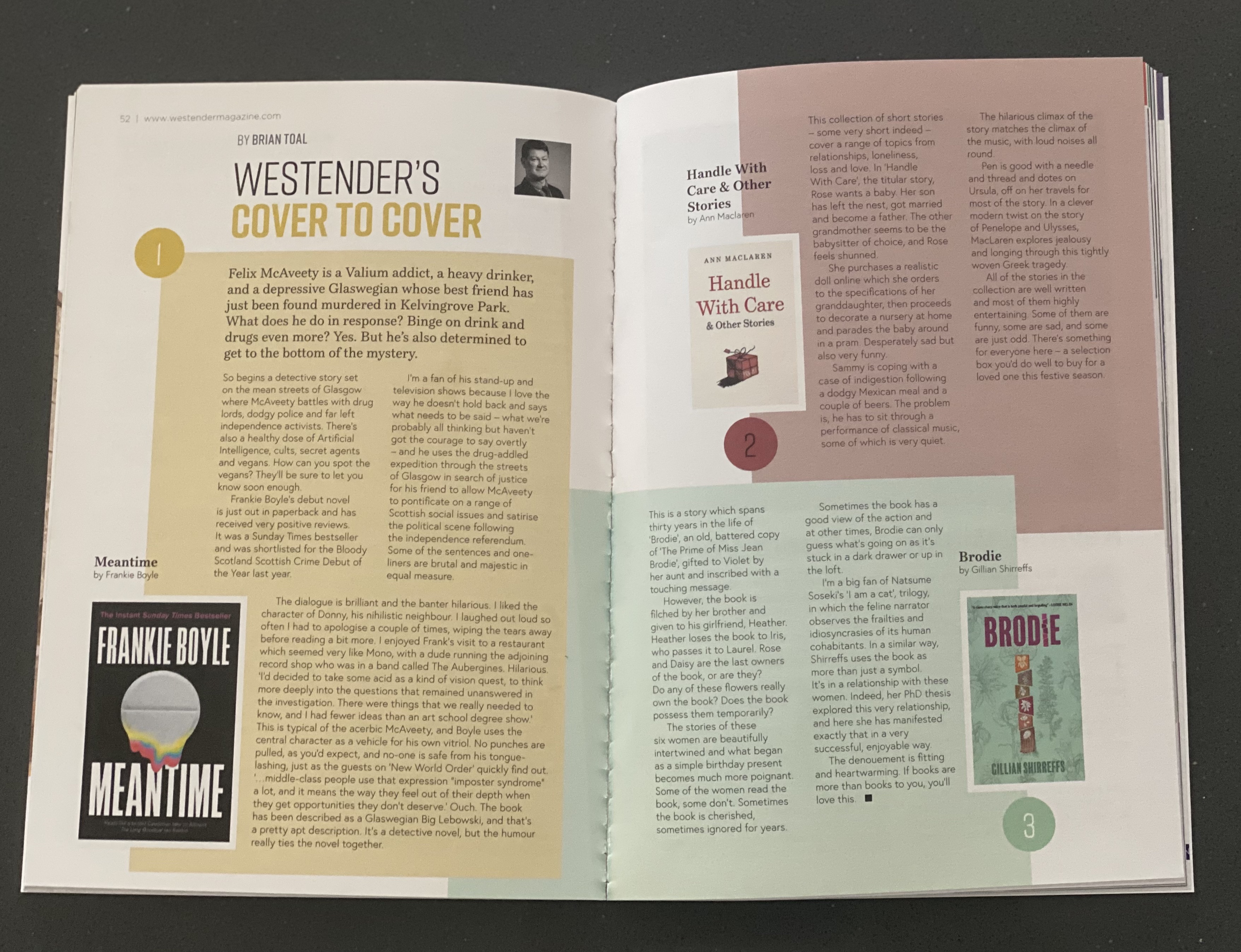
For the Love of Brodie

Brodie has given me nothing but good things and I’m grateful for every one of them. I love a list, so here goes. ..

  1. There was the initial idea and all the fun I had playing with the notion that I could actually write a novel narrated by an inanimate object. This was made all the better because by doing so, I would be able to both explore and explain (albeit in a very allegorical way) what it feels like for me to live with multiple sclerosis.
  2. I had the opportunity to embark on a practice as research doctoral degree. There were other elements to my doctorate, of course, but Brodie was at its heart. And there were so many great things that came along with the doctorate: the opportunity to learn from the brilliant staff and students of the Creative Writing department at Glasgow University; my amazing, generous, supportive supervisors; the fascinating academic research I was able to undertake; all the incredible people I met along the way.
  3. Writing Brodie was a joy. I fought with a lot of words on the way, carving and sculpting, but got so much pleasure from doing so. An added bonus was that when I’m focused on writing, I forget about the nerve pain in my hands (a trick no drug has ever managed to pull off), which meant I had months of pain relief. And as if that’s not enough, I mainly wrote Brodie in the Neenah Public Library (we were living in Wisconsin at the time), which meant I was surrounded by books on a daily basis and who wouldn’t love that!
  4. I had only just graduated with the doctorate (June 2021) when I noticed a lump in my right breast (July 2021) was diagnosed with HER2+ breast cancer (August 2021) and started sixteen months of treatment (September 2021), developing sepsis with the first round of chemo. My mind was full of fear and anxiety, with little room for thoughts of Brodie or publication, but there were the odd moments sitting in waiting rooms or hooked up to a drip in the Beatson when I would try to calm myself, breathe deeply and fantasise about Brodie someday being out in the world and me being healthy and well and able to see it. In this way, Brodie helped me to glimpse a future in the darkest of moments.
  5. My final infusion of TDM1 was on the 29th of December 2022. This marked the end of active treatment. As I walked out of the Beatson Cancer Centre that day, bruised from cannulation and with the beginnings of side effects from that last chemo cycle, I had no idea what the New Year would hold. Two important things 2023 did bring were an invaluable six-week Fear of Recurrence course provided by the Beatson Cancer Charity and an encounter with the friend of a friend. Fortunately for me and Brodie, this friend of a friend was Stephen Cameron, founder of Into Creative. After hearing about my strange book that’s narrated by a book, Stephen was so intrigued, he asked for the manuscript and, long story short, decided Brodie would be the next title published by his imprint, Into Books. (I feel hallelujah music should issue forth from the screen at this point, but sadly I have no such technical skill.) And so began Brodie’s journey to publication with all the good things it would bring.
  6. At some point it crossed my mind that if Brodie was ever published I would give the proceeds to Beatson Cancer Charity. When I mentioned this to my publisher, he was very supportive and agreed to set it up so that any money that should come to me, would go to them instead. This is the greatest gift Brodie has given me – the opportunity to express my heartfelt gratitude for the kindness and care I received during those sixteen months of cancer treatment.
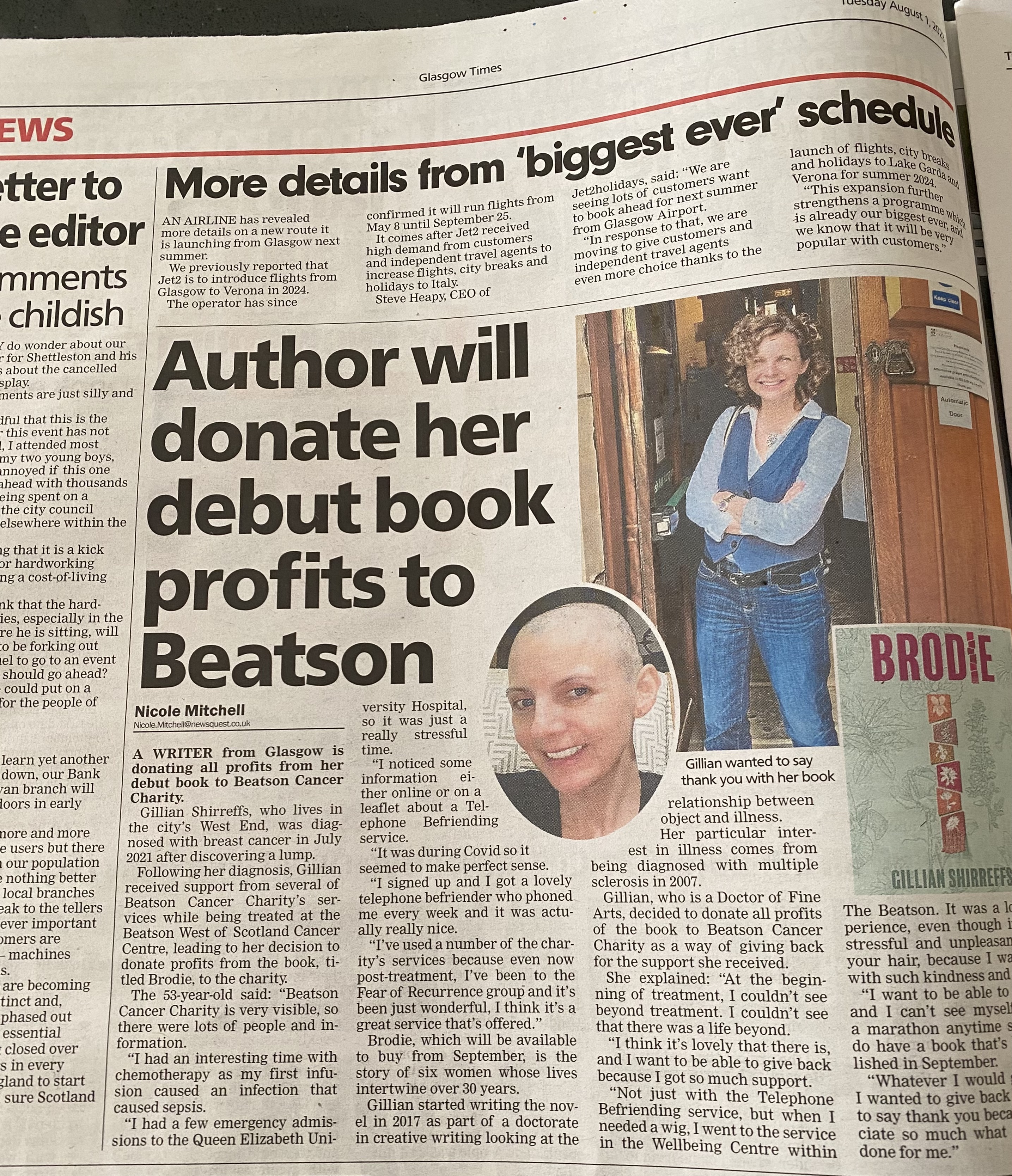
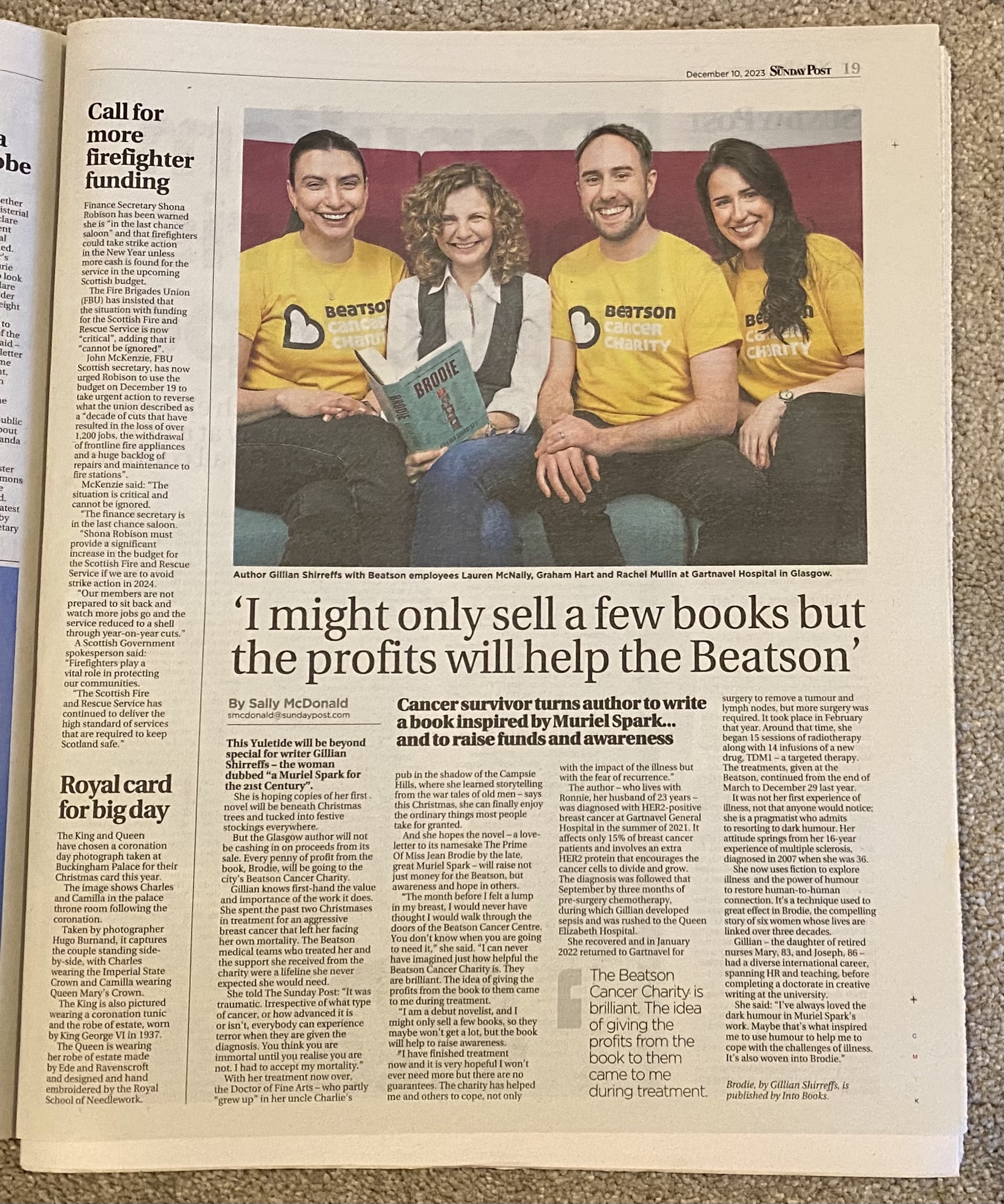
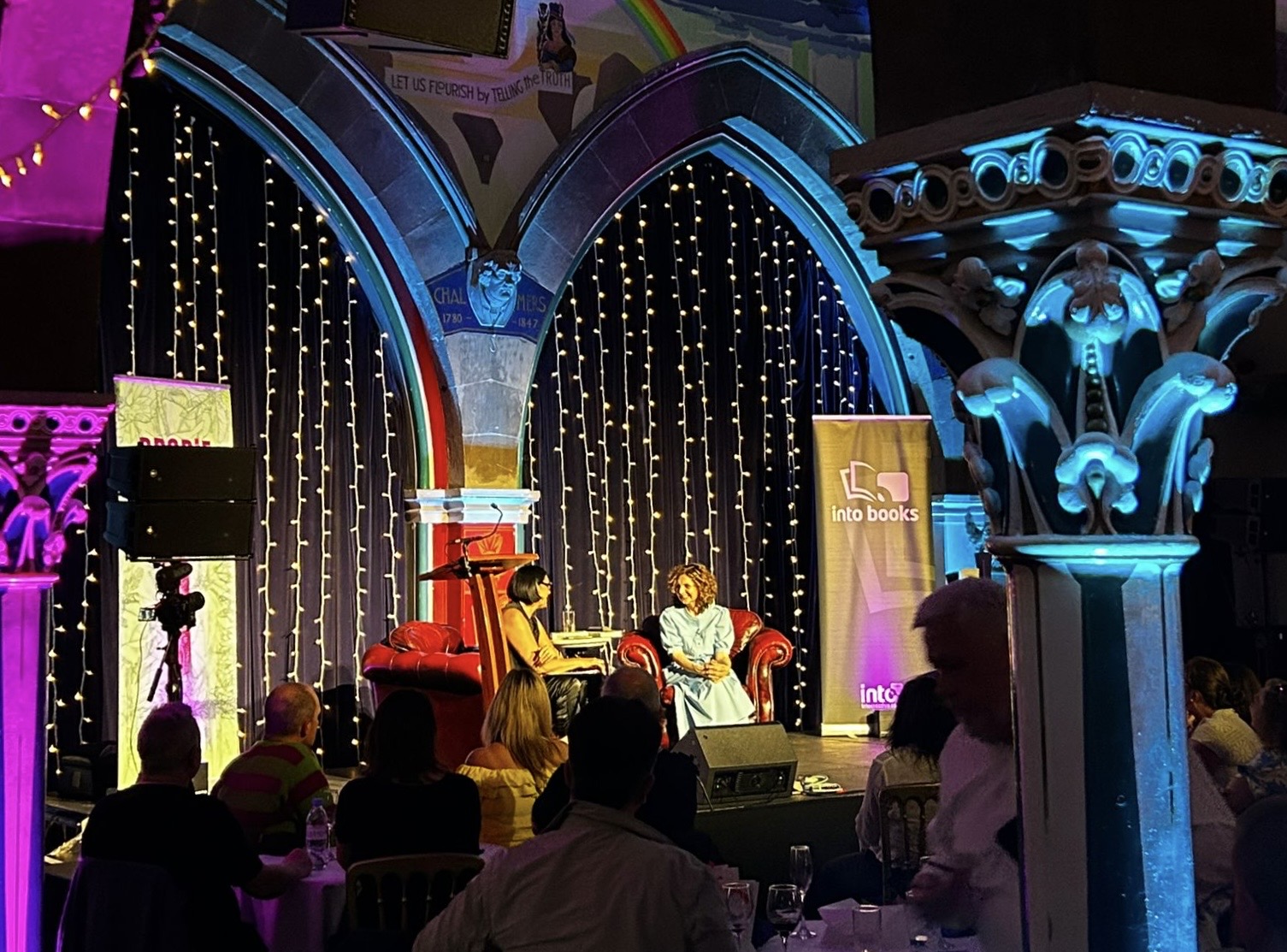
  7. This connection with the Beatson Cancer Charity (BCC) has flowed through everything that has gone on since Into Books first announced Brodie’s imminent arrival in the epic book trailer created by the creative genius who is Stephen Cameron and it led to interviews and newspaper articles in the run up to Brodie’s launch at Òran Mór on Thursday 7th September 2023. A sold out book launch that doubled as a fundraiser for BCC and was supported by amazing journalists, writers and musicians, to whom I will be forever grateful. It was a night I’ll never forget and thanks to Mhairi, we have a video record (contained in the Brodie publication archive below).
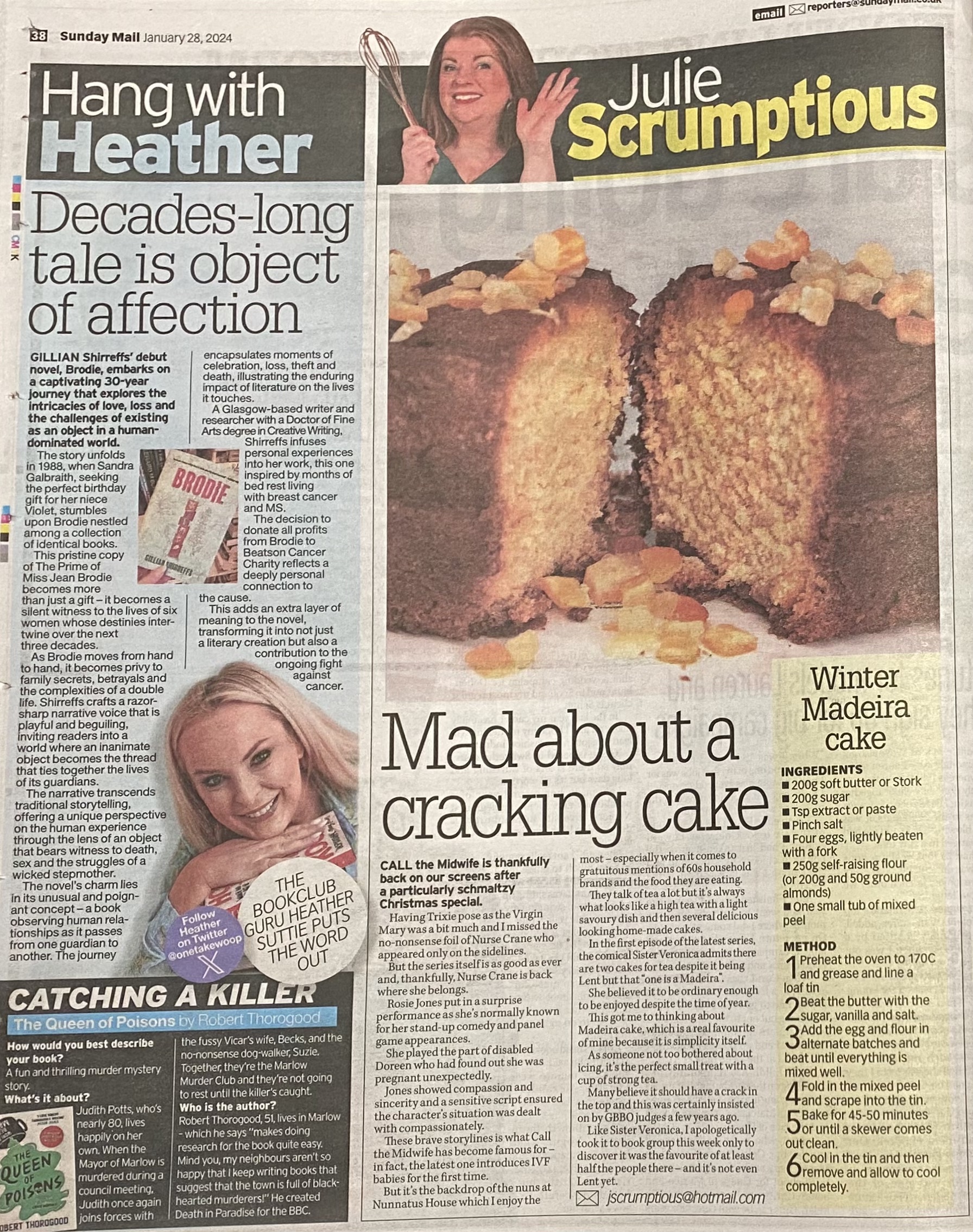
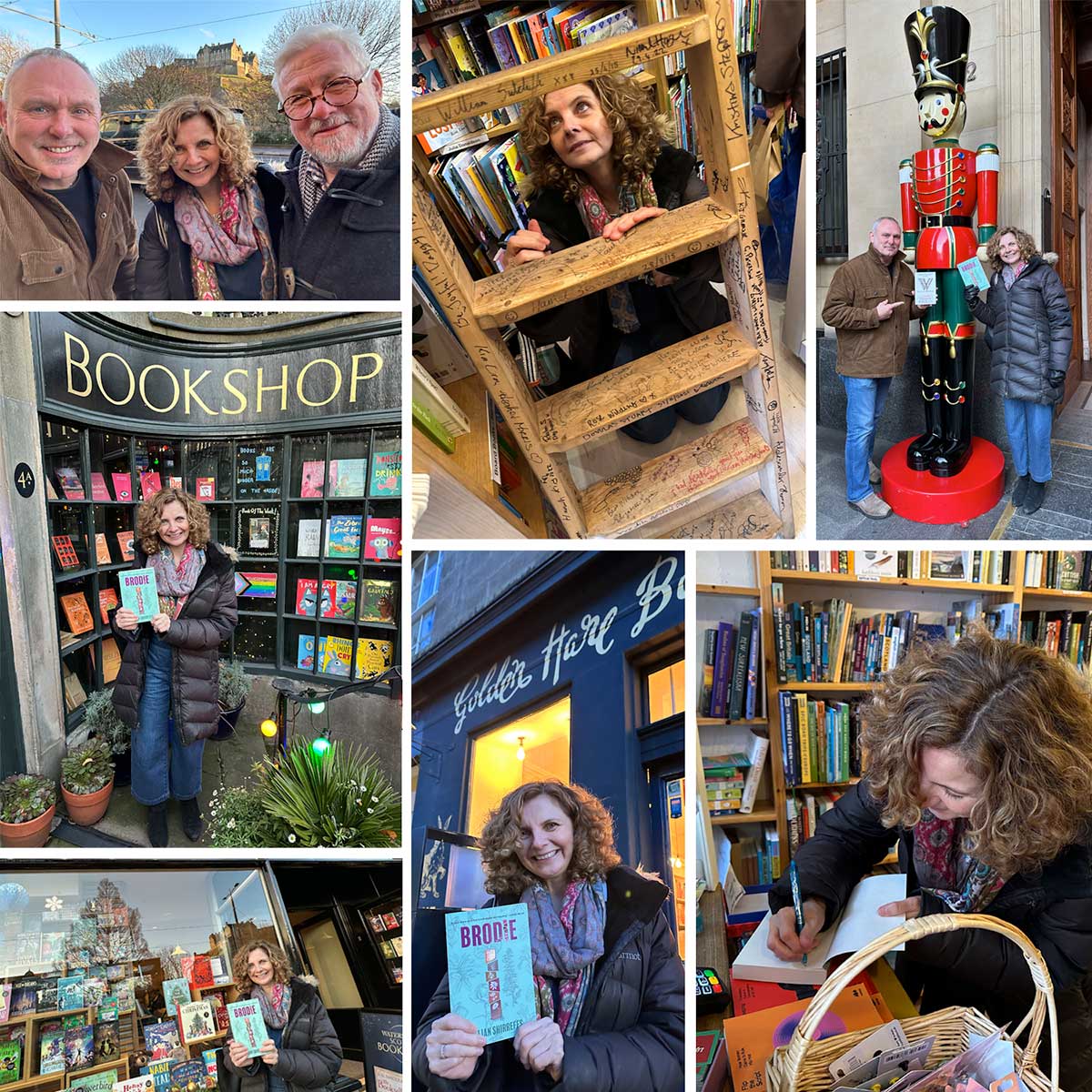
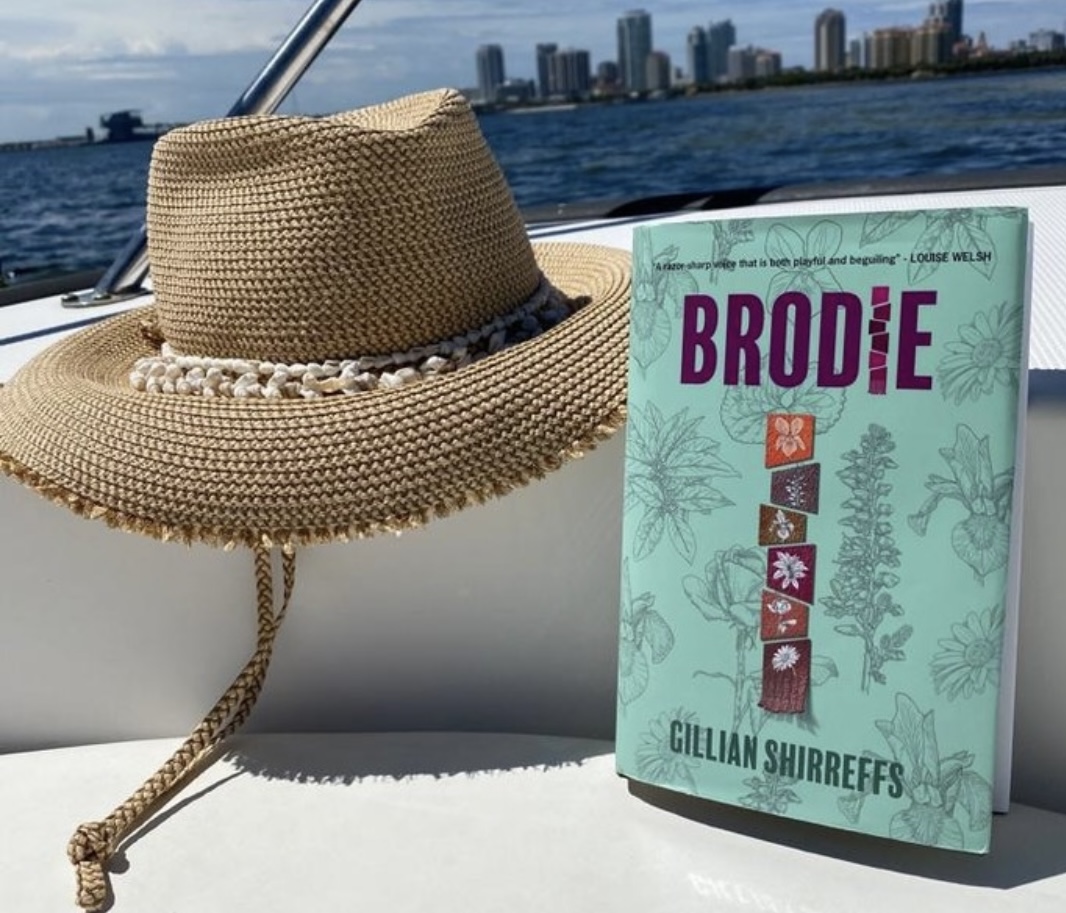
  8. For those who know me well, it will be no surprise that there are eight items in this list. I’ve saved the eighth for all the connections Brodie has gifted me, which feels very appropriate as that is what my novel does – intertwines the lives of six women over thirty years – and thanks to Brodie I am forever connected to the people who have helped me along the way and now to those who have come into my life as a result of this beloved book of mine and who have my deepest gratitude: my Into Creative family; the fabulous folks at BCC; all those who’ve interviewed me or written about Brodie; incredible people like Janice Forsyth who spoke to me on the Afternoon Show on BBC Radio Scotland (the actual, real Janice Forsyth not the Janice who lived in my head and used to help me out with thorny plot points); Daffy who interviewed me on Daffy’s Disc on Go Radio; Zoë Strachan who spoke to me in Caledonia Books on a very wintery Sunday; Alistair Braidwood who interviewed me as part of the brilliant SWH / Into Books collaborative conversations series; Heather Suttie who had me as a guest on her fantastic podcast, the Book Alchemist; and finally, the readers who have taken Brodie to their hearts, sending photos of Brodie from around the world, helping Brodie send me postcards from those adventures and writing lovely reviews that have made me cry.

I also love an archive, so here’s a little one that captures something of Brodie’s publication journey, to date…

An episode of the brilliant Book Alchemist Podcast with the amazing Heather Suttie.

Screenshot
Screenshot

365 Days in 365 Words

I’m not normally big on reviewing the years of my life…

1975 – Started primary school.

1982 – Finished primary and started secondary school.

1988 – Finished secondary school and started university.

1992 – Graduated with my first degree (there would be more) and began a one-year sabbatical as President of the Glasgow University Students’ Representative Council.

And so on, and so forth.

So much gets missed out. For instance…

1975 – Also the year my mum passed her driving test in our bright orange VW ‘Jeans’ Beetle; the ‘Jeans’ denotes the denim upholstery of our very 1970s car. There were metal studs, too.

So, what about 2023… unlike 2021, there was no Viva (passed with no corrections), no breast cancer diagnosis, no chemotherapy, no sepsis, no baldness… unlike 2022, there were no cancer surgeries, no radiotherapy, no immunotherapy (chemo-lite, as I called it).

What there was… a six-week Fear of Recurrence course (thanks to the incredible Beatson Cancer Charity), two trips to the US (work for Ronnie; enjoying the sun and hanging out with some of my favourite people for me), one trip to Italy (San Gimignano, Siena, Volterra, more great friends), the loss of our beloved flat coated retriever Hamish, the addition of our exhausting but very sweet flat coated retriever pup Harris, Brodie’s book launch (yay!), photos of Brodie travelling the world, the hashtag #BrodieOnTour, postcards from Brodie, some brilliant new friends, the chance to reconnect with some lovely old ones, an instance of ghosting (my first; I wouldn’t recommend it), charity events, book events, nice food (and the ability to taste it, including Ronnie’s new prawn and mushroom curry recipe), fantastic books (mainly consumed via Audible – thanks chemo for wrecking my concentration, still), a little writing, a couple of new notebooks in which I jotted ideas and the beginnings of new stories, incredible live music that reminded me how much I love music, a record player, records.

And… thanks to the very difficult years of 2021 and 2022, in 2023 I noticed (and marvelled at) unusual cloud formations, tall trees, the feeling of carpet under my toes, the simple pleasure of having coffee with a friend, the joy of a long drive and a good audiobook.


Day 250

Just after eight this morning, I went for a dog walk. It was unzipped jacket with a light scarf sort of weather. Beautiful blue sky. I was keenly aware of the pavement beneath my feet, the dogs’ leads in my hands, and a deep sense of gratitude.

I’ve been aware of a milestone approaching. Day 250.

250 days since I began treatment for breast cancer, which, in my case, was chemotherapy. 250 days since I walked along a corridor at The Beatson West of Scotland Cancer Centre to the Macmillan Day Case Unit. 250 days since my first infusion of Docetaxel.

What I couldn’t have known on that Thursday was that three days later, just after eight in the morning, I would phone the Beatson emergency helpline to say I was spiking a temp. Or that I would be told to go immediately to the Queen Elizabeth University Hospital, be sent home a few hours later, then phone the emergency line the next day to say I was still spiking a temp and felt dreadful.

I couldn’t have known I would spend seven hours that Monday in a busy, noisy Emergency Department waiting to be seen by a doctor, and when I was, and my blood results came back in the wee small hours, that I would be told I had sepsis.

250 days ago, I had no idea those things would happen. I also didn’t know that I would have four further unplanned hospital admissions. Or anything about the ‘bear hugger’ I would be put in at some point during my third emergency admission because my temperature had dropped so low due to a chemo-induced infection.

I think it’s fair to say that back then I was pretty rubbish at chemotherapy. Had it been an exam, I’d have been lucky to scrape a C.

I’m better at it now.

Granted, the treatment I’ve been on since March (TDM1) is very different from the chemo I had pre-surgery, but, even so, I’d like to think I might be edging towards an A.

My body’s ability to cope with TDM1 is just one of the things I was grateful for on my dog walk this morning. I also felt gratitude for every bit of kindness and care I’ve received over the last eight months. From doctors, nurses, pharmacists, medical secretaries, receptionists, folks at the brilliant Beatson charity, from my family, from neighbours, from friends old and new.

In the last 250 days I’ve had eight cycles of pre-surgical chemo, two surgeries, fifteen sessions of radiotherapy and am now in cycle three (of fourteen) of TDM1 treatment.

I lost my hair, my eyebrows, my eyelashes, my sense of safety, my sense of dignity (did I mention the campylobacter infection that accompanied the sepsis…?), but not my terrible sense of humour.

I couldn’t have managed it without each and every person who wrote me an email, sent me a text, posted me a letter, hand-drew me a card, knitted me a hat, gave me a scarf, bought me thick woolly socks, sent me flowers, went for a walk with me, made me banana bread, supplied me with Pan Drops, sent pyjamas across the Atlantic, carefully chose a book for me, dropped off a care package at the door, said a prayer for me, or took a moment to wish me well.

Getting to day 250 takes a village.

I’m very grateful for mine.
Day 218

It’s 218 days since I first walked along the corridor to the Macmillan Day Case Unit at The Beatson West of Scotland Cancer Centre. 214 days since I was admitted to the Queen Elizabeth University Hospital with neutropenic sepsis. A day since I last walked along the corridor to the Macmillan Day Case Unit.

In the meantime, I’ve had another four unplanned hospital admissions and two planned ones in three different hospitals. The unplanned four were for chemo-related infections and the two planned ones were for surgery.  

It’s a lot.

And that’s okay.

But it’s a lot.

I cry more than I did. It comes on unexpectedly and has a primordial quality. It mainly happens when I’m alone, but sometimes there’s a witness.

In my mind’s eye I see the face of a friend. I facetimed her from hospital 200 days, or so, ago. I didn’t speak. I just cried.

The moment is etched in my memory and whilst I wish it hadn’t happened, for her sake, it’s a reminder that I’m not alone in this. That those who love me are willing to be there even in my most difficult moments; to witness emotion I struggle to identify – anxiety, despair, fear, grief, hopelessness?

Today I cried for reasons I can’t pinpoint. Yesterday I had the double whammy of radiotherapy (13 of 15) and an infusion of TDM1 (2 of 14), so it might simply have been exhaustion. For the first time in 218 days though, I wanted to write about it.

Writing has long, for me, been a way to better understand illness. In my case, multiple sclerosis. To help make sense when there seems to be none.

The desire to return feels good.

Like I’m becoming me again.


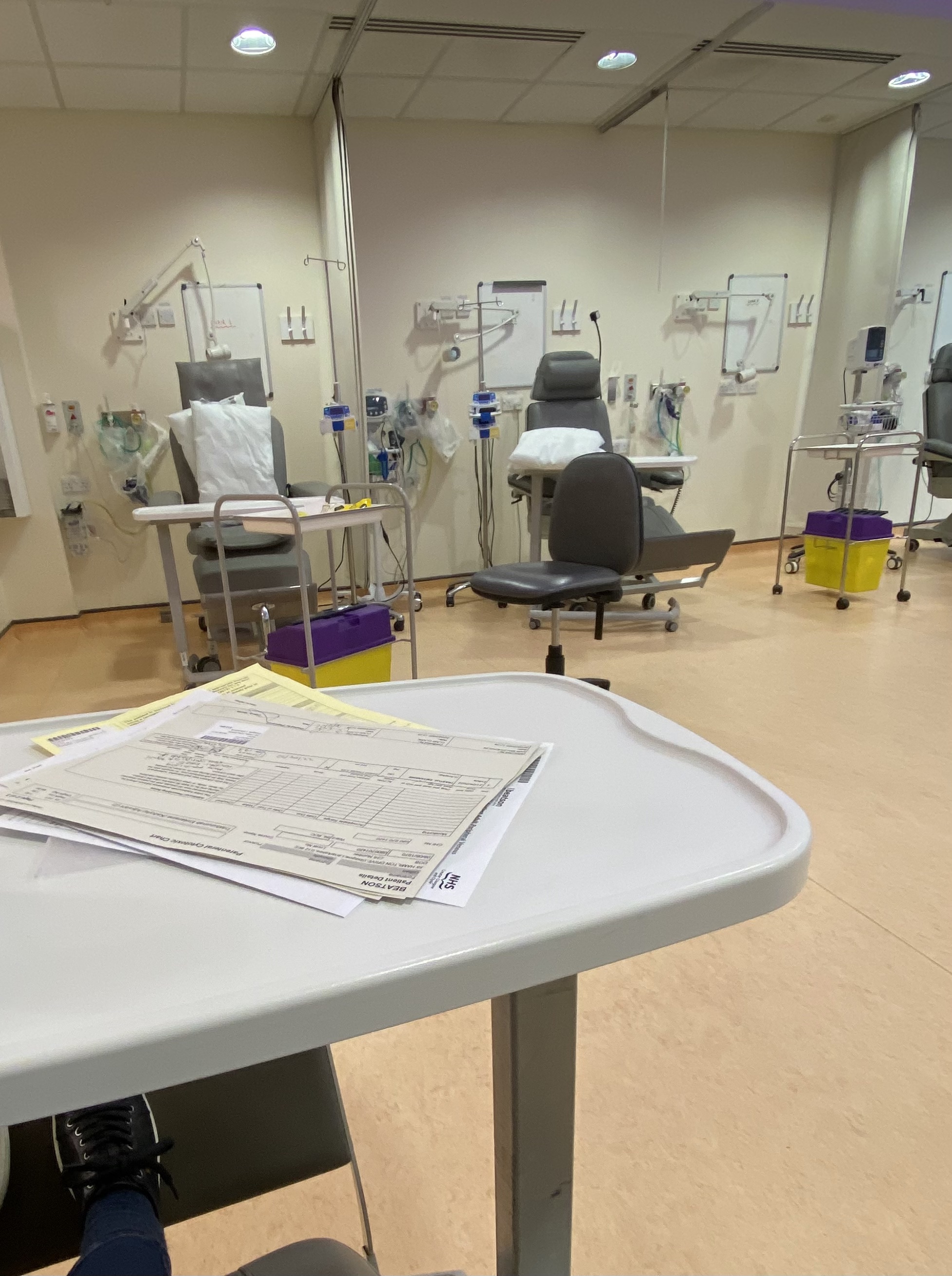
I’ve been collecting objects and images that will someday be included in a project with the working title Artefacts of Illness. The photo below is of Area 2 in the Macmillan Day Case Unit at a little after 6pm yesterday when things were winding down for the day.

it is what it is

It’s been a while. A while of not writing.

A while of having nothing to say.

Except certain phrases:

Don’t get cancer.

It’ll be fine.

It is what it is.

I say them often. On a loop.

Not to the same people.

I seem to reserve Don’t get cancer for friends. People my age, or within fifteen years of my age, give or take. And when I say it, I mean it. Like I can prevent cancer from happening with words; as though I can ordain it to be so; demand that this not happen.

An imperative; an incantation; a command.

I don’t want anyone else to live this experience and yet I now know it’s a concrete possibility. There’s nothing I can do to stop it. Except issue this directive and cross my fingers that words have a power I don’t possess.

Family members are most likely to get It’ll be fine.

And it will be fine.

I feel it in my water and in the kindness and good wishes that encircle me.

I feel it in the treatment I receive. I feel it in the care I’m given. [I’ve learned that treatment and care are not one in the same. This is a thought for another time. A time when I have more words.]

It is what it is seems to be for everyone. It’s indiscriminate and uttered most frequently.

I’d like to have more words. But I don’t. Not yet.

I’ve been told this is a season. A season that will pass.

When it does there will be words.

I promise.

Birds of a Feather

feather-4106529_1920

On March 24th, a friend and I got together over Zoom. We’d both initiated lockdown the previous week, as we both have multiple sclerosis, and thought we might like to use the time to collaborate on some sort of creative enterprise as a way to pass long lockdown days. We’re also both writers. Georgi a poet to my fiction writer.

By the end of the call, we’d signed up to two projects (not quite in blood but with our fiercely perfectionist natures, we might as well have done). The first leant more into Georgi’s artistic disposition and the second into mine.

They Closed the Real World is a Google Doc in which we respond, turn about, to the world in which we find ourselves and to the writing that has been left there the previous day for us. Georgi’s first entry into this document ended with the following: We sit and drum on our keyboards, typing quickly, making sense slowly. We’re safe. Hope you’re safe. Jealous, we listen to the birds. Their real world is open – shifted, yes – but wide and open.

I responded as follows on March 26th: I listen to the noise of the sirens as I once listened to birdsong. Something in me stops. Attends. Imagines the body from which the sound emanates. Metal now, not feathered. No tiny skeletal muscle moving in time to the notes; drawing down morning air and releasing it as music. I think of that Larkin poem. Ambulances. All streets in time are visited.

Socially Responsible Looters is the second Google Doc. It’s very sweary (leaning into my love of expletives) and is a novel in progress. The idea being that two characters meet at Harthill Services just after lockdown has been declared. One is heading east on the M8, the other west. Both sides of the service station have been abandoned. Abby, Georgi’s runaway teenage character makes her way to the other side, where she encounters my character who is a forty-something bundle of backstory and badness.

Neither of us knows anything about the other person’s character or plot intentions and we both seem to derive sadistic pleasure from gifting a tricky twist to start the other’s writing day.

I’m a little numbers obsessed, so copy and paste my Google Doc entries into a Word Doc entitled: G & G Projects. As of today, it has 32,600 words in it. Not bad for 96 days.

We’ve decided to have a little more fun, so met via Zoom on Friday to discuss the Socially Responsible Looters Podcast we plan to do. Watch this space…!

If you’re interested in learning more about our collaboration, Georgi wrote a piece for the MS Society that was published to celebrate National Writing Day on June 24th.

Georgi’s piece


When Pain Doesn’t Define Your Story

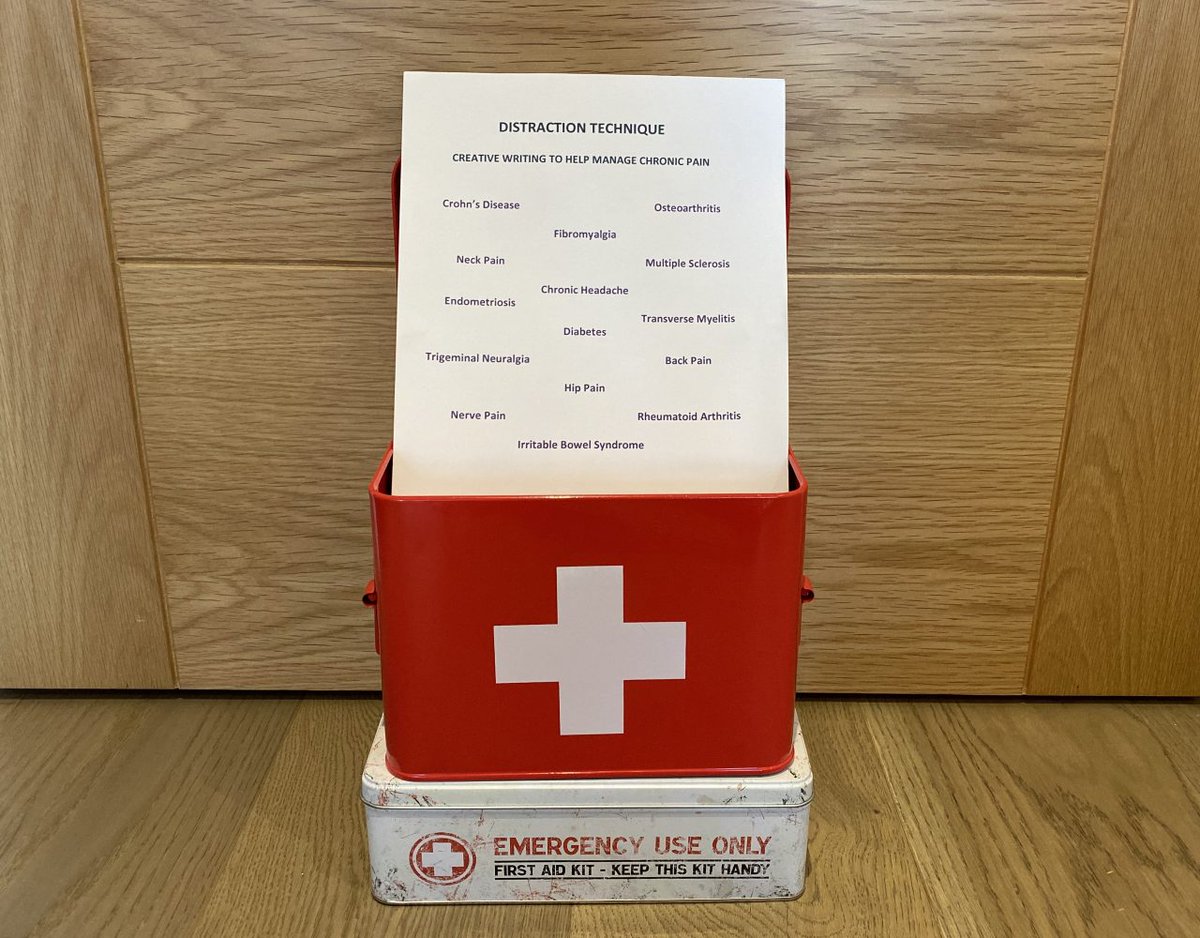
The Writers' First Aid Kit

I’m thrilled to be leading an online fiction writing workshop with Glasgow Women’s Library on June 25th. The one-hour workshop is designed for women who experience chronic pain and offers an opportunity for participants to try out fiction writing as a means of distraction to help manage it.

I discovered the power fiction writing has to distract me from chronic pain, quite by accident. To fill the time during an extended period of bedrest after an MS relapse, I  began to write and noticed that when I was fighting with word after word and sentence after sentence, I didn’t notice my nerve pain (which might normally be described as the sensation of broken bits of glass being pressed into my skin).

I wrote fictional tales inspired by my interest in the people I would see when I ventured out of bed and into the waiting rooms of hospitals, clinics and GP surgeries. I made up stories about the lives of the people I saw: a young man struggling to stand up; a middle-aged couple bickering their way through the dead time until the name of one, or the other, was called; a well-dressed woman speaking quietly into her phone; an elderly couple holding hands.

In this way Ian was born. I gave him a wife, Gemma, and two young sons. I wrote about Sarah and Craig Anderson. Childhood sweethearts who weren’t so sweet on one another anymore. There was Jean and her husband John, married, and in love, for twenty years. Each time, I would give one of them a neurological illness. I was curious to see what effect it would have on them: on their relationships; their friends and their family. Perhaps it was a way for me to explore the future. Importantly, it kept nerve pain at bay.

I thought this might just be something odd about me. Perhaps for others the drugs worked and they didn’t need to resort to writing. Then I read about phantom limb pain, neuroplasticity, distraction technique, and it began to make sense, so I kept writing both for the pain relief and the opportunity to inhabit other people, other places, stories that weren’t my own.

I’m excited to lead the workshop and have others try out fiction writing as a distraction to help manage chronic pain. It’s now fully booked, but we’re planning to hold a second one over the next couple of weeks, so if you’re interested in attending please don’t be put off, just add your name to the waiting list.

ONLINE: Fiction Writing to Help Manage Chronic Pain


Stories from Home

IMG_1068 2I’m thrilled to have work in the anthology, Stories from Home. All the proceeds from its sale are being donated to The Ambulance Staff Charity. TASC offer emotional, financial and community support to paramedics, ambulance crew and their families across the UK. They say of their work, ‘We’re passionate about caring for the mental, physical and financial wellbeing of those who care for us. Because they care, we care.’

In the introduction to Stories from Home, editor Hayleigh Barclay writes, “COVID-19 has brought about numerous changes for us all throughout the world. However, for our Ambulance Service staff, their dedication and frontline care has remained consistent despite facing extraordinary times.” She goes on to explain, “Now more than ever our ambulance crews deserve our appreciation – they are first on hand in an emergency, saving lives before patients even reach the hospital, reassuring relatives whilst simultaneously responding to a crisis.”

My two stories are, Carole and Rumbled.

Carole was written on a spring day in 2018. Our third Wisconsin winter was finally over, or so I thought. After months of frigid temperatures and an outside world hidden under snow, there had been a thaw. Patches of green had become visible for the first time that year. I got up early one morning and everything was white again.

Ronnie was on a work trip to Malaysia so I was home alone with the dogs. I made my first coffee of the morning and sat down in the room in our beloved old Neenah house we called the snug (with its fireplace and bookshelves for walls we couldn’t help but be reminded of a cosy backroom snug in a Scottish pub). I watched the snow inch higher and higher and I began to wonder.

What if. What if today had been the day someone somewhere had planned to do something of consequence. Something they’d been working towards for months.

The snow fell all day long. It obscured everything. My garden. The street beyond. I wrote to its slow, steady rhythm. I conjured up Carole. I invented a life for her. A life changed by an unexpected winter storm that arrived in spring.

My second story is called, Rumbled. I’m not sure it’s a word with which my American friends will be familiar. We use it on this side of the pond (or at least in my bit of Scotland) to denote that the truth about someone or something has been discovered. In this case Susan, the narrator of my story, despite her attempts at misdirection, will be rumbled by the reader.

I’m honoured to have my work included in this anthology. The poems and stories in it are brilliant. Amazing writing with something for everyone to enjoy. My stories are fortunate to keep such fine company.

If you’d like to read the anthology and support the work of TASC as you do, here’s a link for friends in the UK and one for friends in the US.

Happy reading!

Illness: A Narrative in Four Parts, Parts Three and Four

I’m very grateful to The Polyphony for serialising my essay on being diagnosed and living with multiple sclerosis. I much prefer writing fiction, but over the last three years I’ve had to push the boundaries of my comfort zone and write four non-fiction essays as part of my doctoral project on the relationship between object and illness. Illness: A Narrative in Four Parts was the first of these essays. I hope it provides something of a context for my project and for the fiction I write.

If you’re interested in reading more of the essay, here are links to parts three and four.

ILLNESS: A Narrative in Four Parts (Part Three)

ILLNESS: A Narrative in Four Parts (Part Four)

Many thanks to @the_polyphony for serialising my essay and to the wonderful staff and students of @UofGWriting for the encouragement and support I’ve received.

shore-2613538_1920

Illness: A Narrative in Four Parts, Part Two

My four-part hybrid essay is a piece of memoir that explores my experience of being diagnosed with, and living with, multiple sclerosis. In part two: I’m moved from the emergency receiving unit to the skin ward (because there’s a bed in the skin ward); I have to break bad news to loved ones; I spend my first night in a hospital bed; and, in an attempt not to have to spend a second night, I make a bad decision.

https://thepolyphony.org/2020/05/05/illness-a-narrative-in-four-parts-part-two/

With many thanks to @the_polyphony for serialising my essay.

newspapers-444447_1920